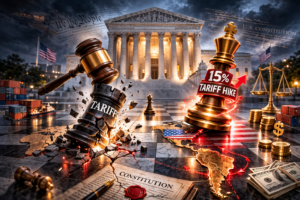
The Waiting Game: Why the Supreme Court’s Silence on Trump Tariffs is Rattling Global Boards

The Waiting Game is really frustrating. People are waiting to see what the Supreme Court will do about the Trump tariffs. There is a lot of silence from the Supreme Court. This is causing problems for companies all around the world. The Trump tariffs are a deal and companies need to know what is going on. The Supreme Courts silence is making it hard for them to make decisions. This is affecting boards and it is a big concern for them. The Trump tariffs are still a topic of discussion and people are waiting to see what will happen next. The Supreme Court needs to say something, about the Trump tariffs so companies can move forward.
WASHINGTON D.C.. You can hear a pin drop in the hallways of the U.S. Supreme Court. They were supposed to make a decision about global trade.. They did not do it. The Justices have put it off again. This is the time they have done this. The case is about the Presidents power to put tariffs on things without asking anyone. This is a deal for companies in Detroit and New Delhi. They are waiting to see what happens. It is costing them a lot of money. The U.S. Supreme Court and the President are still at the center of this issue. The U.S. Supreme Court has to make a decision, about the Presidents authority to impose tariffs under Section 232.
The main issue here is whether the President can use ” security” as a reason to go around Congress and put taxes on things like steel from other countries and expensive computer parts. People who study law thought they would get an answer this week but the Court decided to wait again. This delay shows that the judges are really struggling to agree on how control the President should have over the money of American people. The President and national security are, at the center of this problem.
A Shadow Over the 2026 Supply Chain
For the C-suite this delay is more than a legal issue. It is a problem when it comes to planning. Global manufacturers have spent the year trying to make their supply chains safer but they still do not know what will happen to their costs. The C-suite is worried that their costs could go up by 25 percent at any moment because of a tweet or order from an executive. This is a deal, for the C-suite and Global manufacturers.
“We are not just dealing with logistics anymore we are dealing with a guessing game about what the law will do ” said a senior trade analyst at a think tank in Washington D.C. “Companies are not sure if they should sign contracts that will last a time because they do not know what the Supreme Court will decide about these tariffs. The Supreme Court might stop these tariff powers. They might let them continue forever and companies do not know what to expect from the Supreme Court. This is why companies are hesitant to sign long-term procurement contracts, for logistics and other things.”
The “Green Industry” Collateral Damage
The case started with things like aluminum and steel.. Now it is all about the green transition. The people in charge have used ways to help the companies that make solar panels and batteries for electric vehicles in our country. If the Supreme Court says that these tariffs are not fair or that they need the approval of Congress it could cause problems for the Green New Deal. The Green New Deal is a plan and this could really hurt it. The Green New Deal could be, in trouble if the Supreme Court makes this decision.
People who invest in energy are really worried. If the government suddenly stops charging tariffs it could mean a lot of stuff gets imported, which might make the prices of renewable energy in our country go down really fast. On the hand if the president gets to keep all their power then the United States will keep being like “Fortress America” for a long time which is how things are now. Renewable energy investors are watching this closely because it affects energy a lot. The future of energy is uncertain and that is why investors, in renewable energy are nervous.
Why the Hesitation?
Law experts think the Court is having a time with the Non-delegation Doctrine. The Non-delegation Doctrine is an idea that says Congress cannot just give the President its power to tax. If the Court rules against the administration it will take away an important tool that the White House uses in trade talks. This is especially important now because there is a lot of tension, between countries. The White House really needs this tool to negotiate trade deals and the Courts decision will affect the Non-delegation Doctrine and the Presidents power.
The Court is putting off the decision again. This means that things will stay the same for now. In trade this is a win for protectionism. The threat of tariffs is still there. It is like a card that people can use to get what they want. The Justices do not have to take a side that might upset the right or the industrial left. This way the Court is not making any changes, to international trade or tariffs. International trade and tariffs are still an issue.
The Bottom Line for Business
The Trump Tariff situation is really about something bigger it is about the future of globalization. For companies that do business in India, China and the European Union the Trump Tariff is a sign that things are not going to go to the way they were. The Trump Tariff tells these companies that they should not expect things to be easy with trade like they were, in the 2000s. The Trump Tariff is showing that the idea of trade is not what it used to be.
As the legal world waits for the next “orders list” from the Court, the global economy remains in a defensive crouch. Until the Justices decide where the President’s power ends and the Constitution begins, the only certainty for global traders is more uncertainty.
About The Author