
The Bullion Fever: Nirmala Sitharaman Calm Amidst Global Gold Hoarding and Central Bank Spree
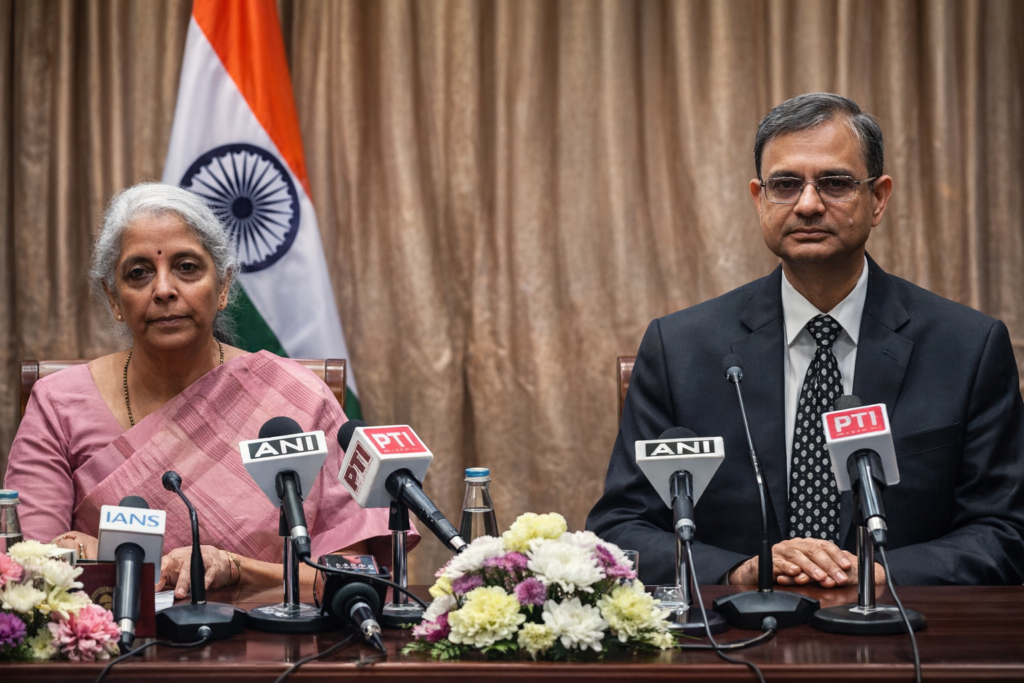
NEW DELHI — As the “yellow metal” continues its roller-coaster ride on global exchanges, Finance Minister Nirmala Sitharaman has signaled a posture of strategic calm. Following the customary post-Budget meeting with the Central Board of Directors of the Reserve Bank of India (RBI) today, Sitharaman downplayed the recent volatility in gold prices, characterizing the surge as a byproduct of a global shift in central bank behavior rather than a domestic crisis.
Despite gold prices hitting a dizzying record high of nearly ₹1,93,000 per 10 grams in late January before a sharp correction and recent rebound to the ₹1,60,000 range, the Finance Minister maintained that demand within India remains within “predictable limits.” Her comments arrive at a time when the “gold versus dollar” debate has moved from the fringes of economic theory to the center of national reserves strategy.
The “Global Gluttony”: Why Central Banks are Hoarding
Sitharaman’s primary thesis for the price spike is not the traditional Indian wedding season, but a fundamental change in how world governments view their “rainy day” funds. “Most countries today, particularly their central banks, are buying gold and silver and storing them,” she noted during the press conference. “The spike is largely due to central banks also buying and storing… much beyond the usual increases and fluctuations.” This observation is backed by a seismic shift in global finance. As geopolitical tensions simmer and the U.S. continues to utilize its currency as a tool of foreign policy, nations in the Global South including India are diversifying their portfolios. Reports indicate that India’s holdings of U.S. Treasuries have recently slid to a five-year low as the RBI pivots toward hard assets. By “decoupling from the dollar,” the central bank is effectively building a golden fortress to insulate the Rupee from the whims of Western monetary policy and potential trade tariffs.
The Indian Household: A “Price-Sensitive” Romance
For the average Indian family, the Finance Minister’s “nothing to see here” approach might feel slightly at odds with the sticker shock at the local jeweler. However, Sitharaman emphasized that Indian demand is fundamentally different from the speculative frenzies seen in the futures markets.
“Gold has always been a favored investment for Indian households. We are watching it, but I’m not sure it has reached such alarming proportions. It has not gone beyond a certain limit.”
Data from the first half of February suggests that while prices remain elevated, the actual volume of gold being consumed by households has shown significant price elasticity. In simpler terms: Indians are still buying gold for rituals and security, but they are buying less of it as the price per gram climbs. This reduction in volume has served as a natural “cooling mechanism” for the economy, preventing a blowout in the nation’s trade deficit.
The RBI’s “Steady Hand” and the Import Bill
Standing alongside the Finance Minister, RBI Governor Sanjay Malhotra provided the hard data to support the government’s optimism. He revealed that despite the price surge, the actual order value of gold imports did not see a significant jump for most of the fiscal year ending December 2025.
The logic is a classic economic trade-off: higher prices were offset by lower import volumes. However, January 2026 proved to be an anomaly, seeing a “sudden spurt” in both value and volume a trend the central bank is currently dissecting.
- The CAD Cushion: The RBI currently projects the Current Account Deficit (CAD) to remain at a manageable 1% of GDP.
- Liquidity Buffer: The central bank remains committed to providing “durable liquidity” for productive needs, even as it navigates the inflationary pressures of high bullion prices.
- The Tariff Factor: With the U.S. recently threatening a 15% emergency tariff on global imports, the RBI is keeping its reserves “heavy on gold” to ensure it has the liquidity to defend the Rupee if trade wars escalate.
The Rise of Digital Gold and ETFs
One of the most striking developments discussed at the summit was the formalization of gold savings. In January 2026, inflows into Gold ETFs in India actually surpassed those into equity mutual funds a rare feat in a market traditionally obsessed with stocks.
This shift toward “paper gold” and digital platforms like UPI-based gold purchases (which saw a 90% month-on-month increase) suggests that the Indian investor is becoming more sophisticated. They are no longer just buying jewelry to wear; they are buying the asset class to hedge against inflation. This “formalization” is a double-edged sword: while it brings transparency, it still ultimately necessitates the physical import of gold by the fund houses, maintaining pressure on the national import bill.
A Golden Standoff
As the press conference concluded, the message was clear: the Indian government views the current gold surge as a global phenomenon that India is well-positioned to weather. By framing the price hikes as a result of “central bank hoarding” elsewhere, Sitharaman has successfully shifted the narrative away from domestic mismanagement and toward a broader story of global financial realignments.
While the “alarming proportions” have not yet been reached, the “yellow metal” remains the ultimate barometer of global anxiety. As long as central banks continue their buying spree, the floor for gold prices is likely to stay high, forcing Indian consumers to adjust to a “new normal” where the family jewels are not just a tradition, but a high-stakes geopolitical asset
About The Author


